| List of Pipe Organ Profiles | Pipe Organ Profiles Home | N8RRB Home | E-mail the Webmaster |
| St. Agatha Catholic Church - 2/43 Bedient | Main Page | Great Division | Swell Division | Pedal Division | Console | Facade |
Other Photos | Stop List |
St. Agatha Catholic Church
Upper Arlington, OH
2/43 Bedient
Opus 75 - 2005
Organ Façade
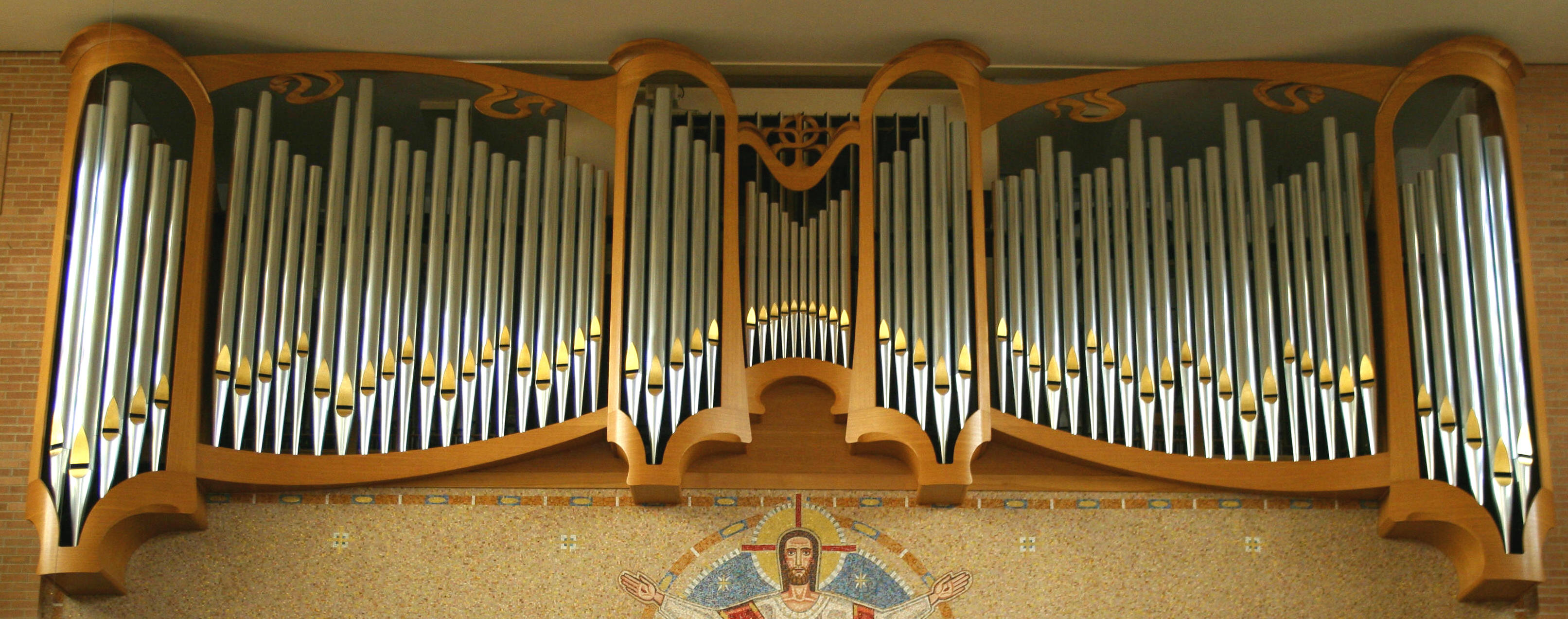
One of the
things which makes the
St. Agatha Bedient pipe organ so impressive is its facade. Without
making a sound, the silver and gold pipes make a bold statement as they
stand tall above the altar area of the church. It is one of the first
things a person sees when entering the church, and it shows how with a
little creativity, a builder can create a work of art of sorts. However
there's more to the facade than meets the eye.
The facade is used to cover the less sightly parts of the organ and organ chamber. There are 70 pipes in the facade, made up of parts of four different ranks, as well as 10 "dummy" or non-speaking pipes. The four ranks are the 16' Great Principal, the 8' Great Principal, the 8' Flute Harmonique, and the 8' Pedal Principal extended down to 16'. The use of dummy pipes is common in organ facades.
Pipes are either placed in line as one plays up the scale, or are placed in an alternating pattern which is how they are on this organ. For example, in the photo above the large pipe sticking down the most on the left side is G#, while on the right side the pipe in the same spot is A which is the next note on the scale. The pipe next to G# on the left side is A#, the pipe next to A on the right side is B, and so on. It is also typical on most organs to have the largest pipe on the left side. If you look closely, you can tell that the pipes on the left side are slightly taller than those on the right.
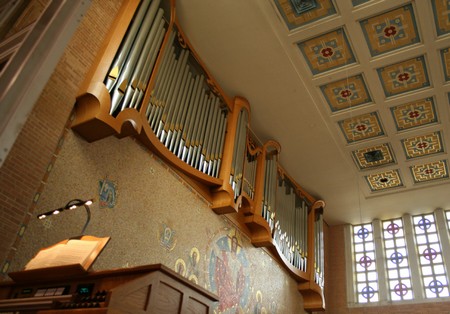
As mentioned on the main page, organ builder Bedient Pipe Organ Company was very creative in its design of the organ. It did what it could to make the most use out of the space available in the wide but very narrow pipe chamber. As can be seen in the photo to the left, Bedient used the facade to create more depth in the pipe chamber. Every single pipe in the facade sits outside the chamber with some pipes sticking out more than others. By doing so, it allowed the builder to add additional larger pipes which otherwise would have been next to impossible to have as a part of the organ.
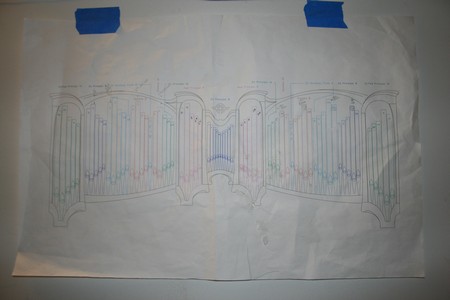
Tucked away in the lower part of the pipe chamber is a road map of sorts. It is a computer drawing by Bedient of the facade, complete with the names and pitches of all 70 pipes. Need to tune the pipe of pitch E on the 16' Principal rank? Check out the drawing and you'll see that E is the fifth pipe from the left. This drawing also notes the 10 dummy pipes in the facade. It is nearly impossible to tell that the pipes in the facade represent multiple ranks of pipes, or that some do not speak. Bedient constructed the pipes with tuning slides in such a way that they cannot be seen from the front, thus everything looks like it is from the same rank of pipes.
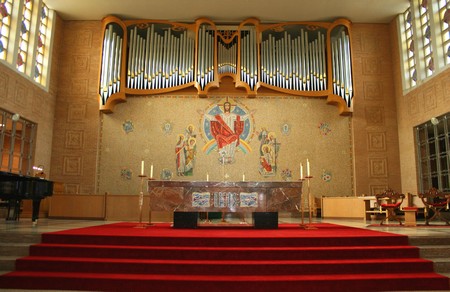 There are 70 pipes in the facade. Whether
this was an arbitrary number, a coincidence, or by design is something to ponder.
There are 70 pipes in the facade. Whether
this was an arbitrary number, a coincidence, or by design is something to ponder.
A rank of pipes generally has 61 individual pipes. The facade has 10 "dummy" pipes and is made up of multiple ranks so more than one rank is shown. Pedal ranks (what is represented in the facade) usually are smaller, sometimes as small as 12 pipes but could also be a full rank. Since we have a couple ranks showing, even dividing 60 by two or three makes for an odd number of pipes.
The number 70 has Biblical significance, being the product of two numbers signifying "perfection", 7 and 10. Sometimes the number 10 also signifies "order", or "the perfection of Divine order".
So by putting 70 pipes in the facade, was Bedient acknowledging the significance of certain numbers in the Bible, or making a statement a statement about the instrument, or was it purely a coincidence?
The facade is used to cover the less sightly parts of the organ and organ chamber. There are 70 pipes in the facade, made up of parts of four different ranks, as well as 10 "dummy" or non-speaking pipes. The four ranks are the 16' Great Principal, the 8' Great Principal, the 8' Flute Harmonique, and the 8' Pedal Principal extended down to 16'. The use of dummy pipes is common in organ facades.
Pipes are either placed in line as one plays up the scale, or are placed in an alternating pattern which is how they are on this organ. For example, in the photo above the large pipe sticking down the most on the left side is G#, while on the right side the pipe in the same spot is A which is the next note on the scale. The pipe next to G# on the left side is A#, the pipe next to A on the right side is B, and so on. It is also typical on most organs to have the largest pipe on the left side. If you look closely, you can tell that the pipes on the left side are slightly taller than those on the right.

As mentioned on the main page, organ builder Bedient Pipe Organ Company was very creative in its design of the organ. It did what it could to make the most use out of the space available in the wide but very narrow pipe chamber. As can be seen in the photo to the left, Bedient used the facade to create more depth in the pipe chamber. Every single pipe in the facade sits outside the chamber with some pipes sticking out more than others. By doing so, it allowed the builder to add additional larger pipes which otherwise would have been next to impossible to have as a part of the organ.
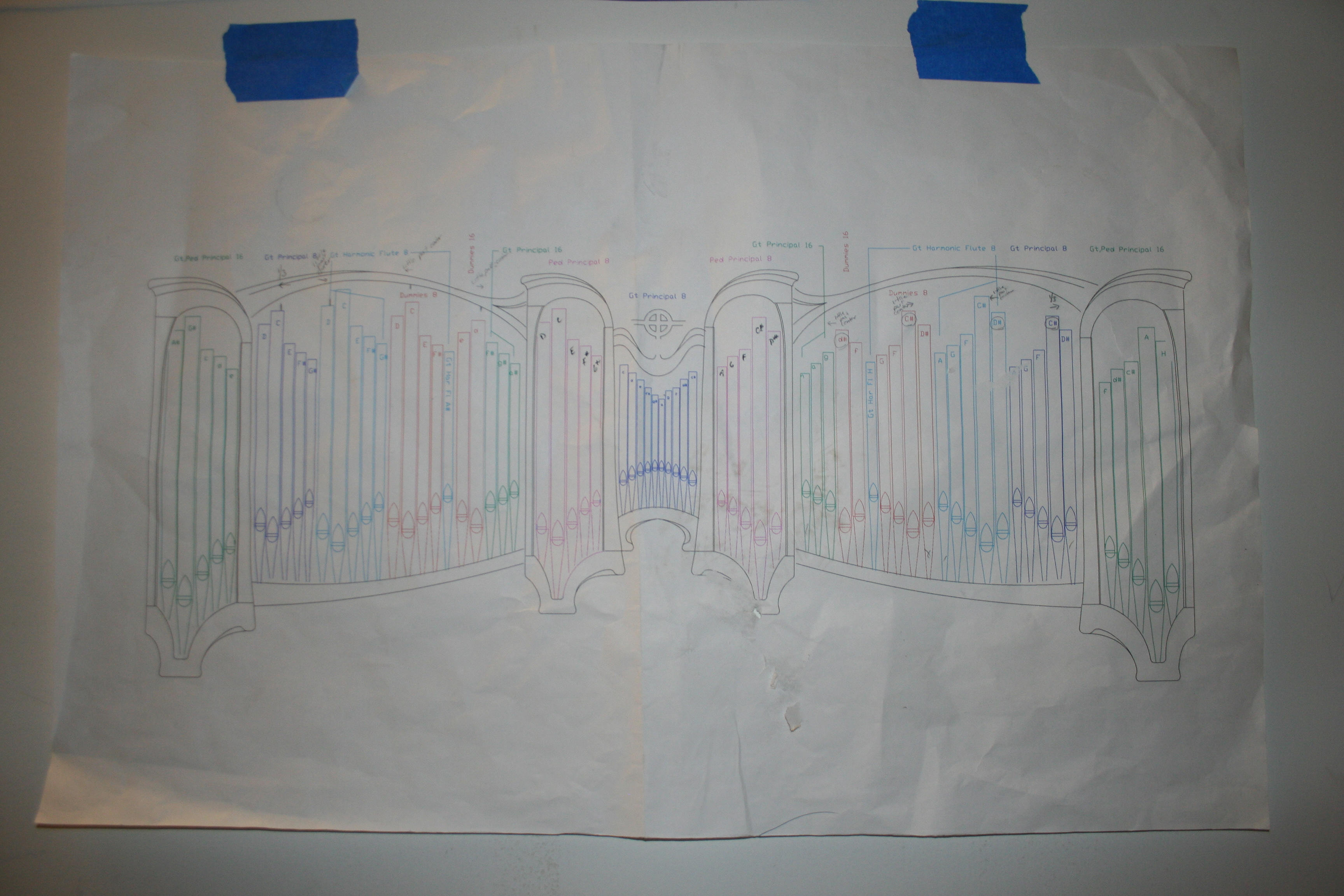
Tucked away in the lower part of the pipe chamber is a road map of sorts. It is a computer drawing by Bedient of the facade, complete with the names and pitches of all 70 pipes. Need to tune the pipe of pitch E on the 16' Principal rank? Check out the drawing and you'll see that E is the fifth pipe from the left. This drawing also notes the 10 dummy pipes in the facade. It is nearly impossible to tell that the pipes in the facade represent multiple ranks of pipes, or that some do not speak. Bedient constructed the pipes with tuning slides in such a way that they cannot be seen from the front, thus everything looks like it is from the same rank of pipes.
 There are 70 pipes in the facade. Whether
this was an arbitrary number, a coincidence, or by design is something to ponder.
There are 70 pipes in the facade. Whether
this was an arbitrary number, a coincidence, or by design is something to ponder. A rank of pipes generally has 61 individual pipes. The facade has 10 "dummy" pipes and is made up of multiple ranks so more than one rank is shown. Pedal ranks (what is represented in the facade) usually are smaller, sometimes as small as 12 pipes but could also be a full rank. Since we have a couple ranks showing, even dividing 60 by two or three makes for an odd number of pipes.
The number 70 has Biblical significance, being the product of two numbers signifying "perfection", 7 and 10. Sometimes the number 10 also signifies "order", or "the perfection of Divine order".
So by putting 70 pipes in the facade, was Bedient acknowledging the significance of certain numbers in the Bible, or making a statement a statement about the instrument, or was it purely a coincidence?
| St. Agatha Catholic Church - 2/43 Bedient | Main Page | Great Division | Swell Division | Pedal Division | Console | Facade | Other Photos | Stop List |